Trilobites: The Dominant Arthropods of the Paleozoic Era
Discover the incredible 300-million-year history of trilobites, the armored marine icons that ruled the Paleozoic seas with high-tech eyes and diverse adaptations.
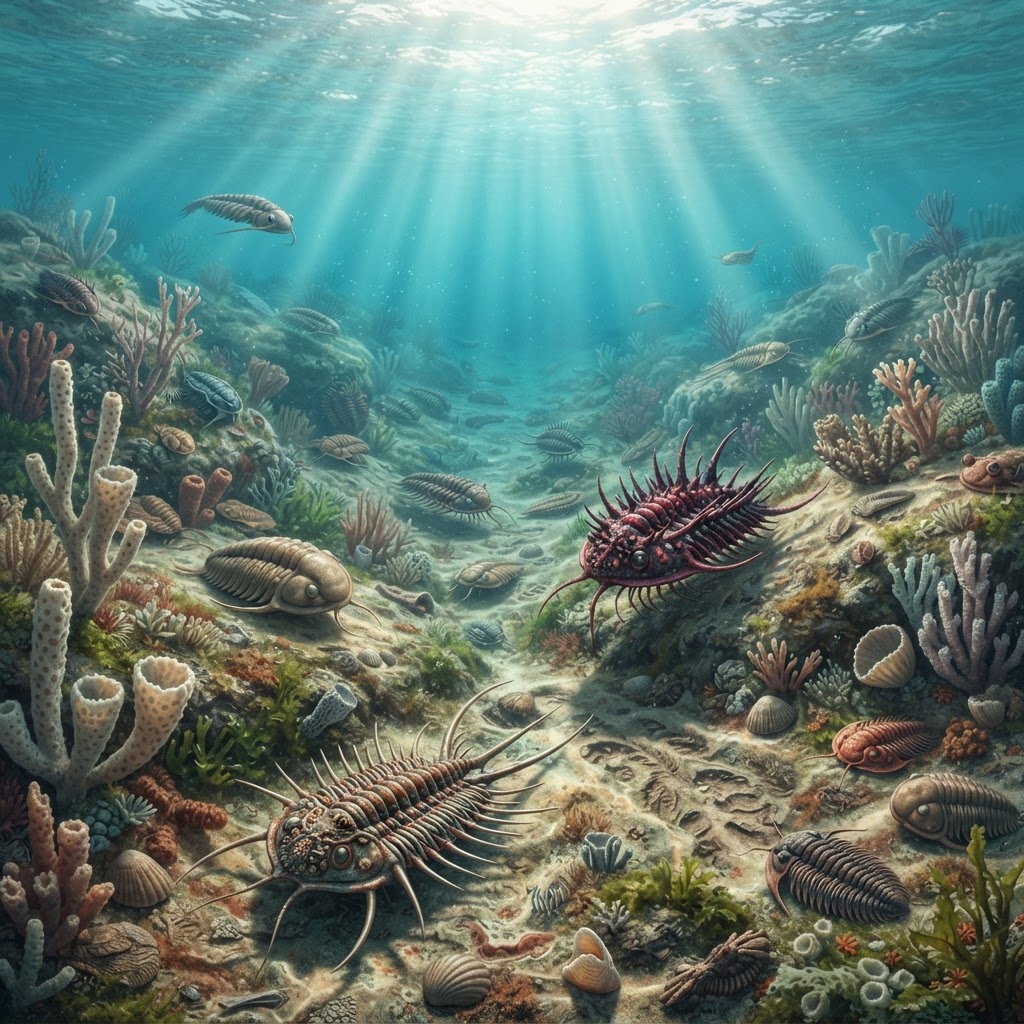
Trilobites: The Dominant Arthropods of the Paleozoic Era
Long before the first dinosaurs shook the earth, the ancient oceans were ruled by a group of armored pioneers known as trilobites. These remarkable creatures were among the most successful animals to ever exist, thriving for nearly 300 million years. From the dawn of the Cambrian Period to the devastating mass extinction at the end of the Permian, trilobites were the ultimate survivors of the Paleozoic Era. As a FossilFlip user, understanding these creatures is your first step into the deep history of our planet. In this guide, we will explore why these arthropods were so dominant, how they lived, and what their fossils tell us today.
What Exactly Was a Trilobite?
Trilobites are a group of extinct marine arthropods that belong to the class Trilobita. They are distant relatives of modern-day arthropods like horseshoe crabs, spiders, and lobsters, though they are not the direct ancestors of any living group. According to Oxford University Museum of Natural History, they first appeared in the fossil record approximately 521 million years ago, shortly after the start of the Cambrian Period.
The name "trilobite" comes from their unique body plan. Many people mistakenly think the name refers to the three segments of their body (head, body, and tail), but it actually refers to the three longitudinal lobes that run down the length of their body: a central axial lobe and two lateral pleural lobes. This distinctive three-lobed structure is what makes them so easy to identify in the field.
The Anatomy of an Ancient Icon
Trilobites were the masters of adaptation. Over their long history, more than 22,000 species have been described, ranging in size from a tiny 6 millimeters to a massive 70 centimeters in length, as noted by Wikipedia. Their success was largely due to their versatile anatomy.
The Three Body Segments
While the "lobes" run vertically, the trilobite body is also divided horizontally into three main sections:
- The Cephalon (Head): This area contained the sensory organs, including the mouth and the eyes. The cephalon was often a single, solid shield that protected the animal's vital organs.
- The Thorax (Middle): This was the flexible part of the body, made up of multiple jointed segments. This flexibility allowed many trilobites to roll into a tight ball for protection, much like a modern pill bug.
- The Pygidium (Tail): The tail section was formed from fused segments and varied greatly in size between species. Some had tiny tails, while others had pygidiums as large as their heads.
High-Tech Vision: Calcite Eyes
One of the most fascinating features of trilobites was their eyes. Unlike the soft lenses found in human eyes, trilobites had compound eyes made of solid calcite crystals. These were the first sophisticated visual systems in the animal kingdom. According to Fossils UK, some species had eyes with an incredible depth of field, allowing them to spot predators or prey from almost any angle. Some trilobites even evolved "tower eyes" that acted like periscopes while they were buried in the sand!
A 300-Million-Year Success Story
The reign of the trilobites spanned almost the entire Paleozoic Era. Their history is a testament to evolutionary resilience.
The Cambrian Explosion
Trilobites exploded onto the scene during the Cambrian Period (541–485 million years ago). During this time, they diversified rapidly, filling every available niche in the ocean. Some were scavengers crawling along the seafloor, while others were active predators or filter feeders. As FossilEra.com explains, they were the most dominant group of animals during this period, making them the "face" of early complex life.
The Ordovician and Devonian Peaks
As the Paleozoic progressed through the Ordovician and Silurian periods, trilobites continued to evolve elaborate defenses. Some grew long, intimidating spines to deter the rising population of predatory fish. Others developed the ability to burrow deep into the sediment. By the Devonian Period, trilobites had reached a peak of morphological diversity, with some species sporting bizarre, alien-like head shields and ornate ornamentation.
Survival and Adaptation
Why did trilobites last so long? Their secret lay in their exoskeleton. Made of chitin and calcite, this hard outer shell provided excellent protection. However, because the shell was rigid, trilobites had to molt (shed their skin) to grow. Many of the trilobite fossils we find today are actually these discarded molts rather than the animal itself!
Their diets were just as varied as their shapes. Some species were detritivores, eating organic matter from the mud, while others were pelagic, swimming in the open ocean and feeding on plankton. This ecological flexibility allowed them to survive several smaller mass extinctions that wiped out other groups.
The End of the Reign: The Great Dying
Despite their incredible resilience, the trilobites could not survive the "Great Dying." This event, known as the Permian-Triassic mass extinction, occurred about 252 million years ago. It was the most severe extinction event in Earth's history, wiping out about 96% of all marine species.
As Britannica notes, trilobite populations had already been declining for millions of years before the final blow. Changes in sea levels, ocean chemistry, and the rise of more advanced predators eventually pushed these ancient icons to the brink. When the Permian extinction hit, the last remaining trilobite orders vanished forever, marking the end of a nearly 300-million-year dynasty.
Frequently Asked Questions
Are trilobites related to cockroaches?
While both are arthropods, they are not closely related. Trilobites are in their own extinct class (Trilobita). They are more closely related to modern chelicerates, such as spiders, scorpions, and horseshoe crabs, than they are to insects like cockroaches.
Where is the best place to find trilobite fossils?
Trilobite fossils are found on every continent. Famous sites include the Wheeler Shale in Utah (USA), the Jebel Saghro region in Morocco, and various sites across the United Kingdom and Czech Republic. Always check local laws before collecting fossils!
Why did some trilobites have spines?
Spines served several purposes. The most common reason was defense against predators like early fish and cephalopods. Spines could also act like "snowshoes" to help the trilobite stay on top of soft mud or help stabilize the animal in strong ocean currents.
How can I tell if a trilobite fossil is real?
Real fossils often show slight asymmetries, tiny imperfections, or evidence of the rock matrix they were found in. High-quality fakes (often made of resin or plaster) are common in the market, especially for elaborate spiny species. Using an app like FossilFlip can help you identify the specific features of genuine specimens!