The Jurassic Period: A Beginner's Guide to the Age of Giants
Step back 200 million years to explore the Jurassic Period, an era of shifting continents, lush tropical climates, and the rise of Earth's most iconic dinosaurs.
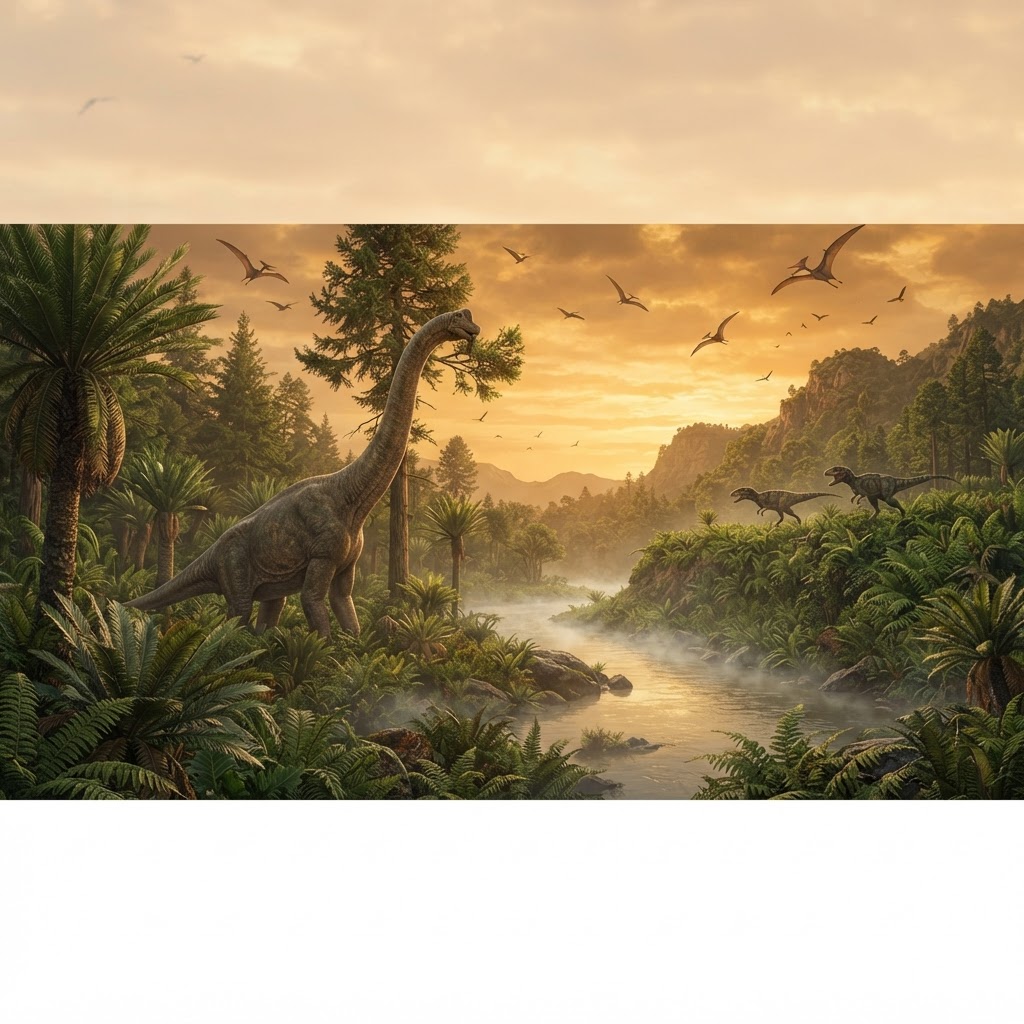
The Jurassic Period is perhaps the most famous slice of Earth's history, immortalized by pop culture as the ultimate age of dinosaurs. Spanning from approximately 201.3 to 145 million years ago, this middle segment of the Mesozoic Era was a time of profound transformation. It was an era where the world transitioned from the dry, harsh landscapes of the Triassic into a lush, green greenhouse world that allowed life to reach gargantuan proportions. Whether you are a fossil hunter using FossilFlip or a curious student of history, understanding the Jurassic is key to unlocking the story of our planet.
The Geography of a Changing World
At the start of the Jurassic, the Earth’s landmasses were still clustered into the supercontinent known as Pangea. However, this massive continent began to rift and pull apart during this period, a process that fundamentally changed the planet's face. According to Active Wild, Pangea split into two smaller supercontinents: Laurasia in the north (which would become North America, Europe, and Asia) and Gondwana in the south (South America, Africa, Australia, Antarctica, and India).
This tectonic breakup created new coastlines and opened up the Tethys Ocean, allowing moisture to reach previously arid inland areas. As the continents drifted, the formation of the Jura Mountains—located on the border of modern-day France and Switzerland—began, eventually giving the period its name National History Museum.
A Greenhouse Climate
If you could travel back to the Jurassic, the first thing you would notice is the heat. The climate was significantly warmer than it is today, with global temperatures averaging 5–10°C (9–18°F) higher than modern levels Wikipedia.
A World Without Ice
One of the most striking features of the Jurassic was the total absence of polar ice caps. Because the Earth was so warm, lush vegetation grew even near the poles. Geochemical evidence suggests that tropical surface waters reached about 20°C (68°F), creating a humid, subtropical environment across much of the globe Britannica.
The Rise of the Rainforests
This warm, wet climate acted like a global greenhouse. The arid deserts of the Triassic were replaced by vast, steaming jungles and floodplains. These conditions were perfect for the growth of ferns, cycads, and ginkgoes. Conifers, including ancestors of modern redwoods, became the dominant trees, spreading across the continents in a near-cosmopolitan distribution ScienceDirect.
The Golden Age of Dinosaurs
While dinosaurs first appeared in the Triassic, the Jurassic was their true "Golden Age." Following a mass extinction at the end of the Triassic that wiped out 80% of species, dinosaurs radiated into the vacant ecological niches to become the dominant land animals National History Museum.
The Gentle Giants: Sauropods
The Jurassic is best known for the sauropods—long-necked, long-tailed herbivores that were the largest land animals to ever live. Iconic species like Brachiosaurus, Diplodocus, and Apatosaurus roamed the floodplains, using their massive necks to reach high-canopy vegetation UCMP Berkeley. To put their size in perspective, a Diplodocus was roughly 27 meters (87 feet) long; sprinting from its head to its tail would take a human about four seconds National Park Service.
The Apex Predators: Theropods
Where there are herbivores, there are hunters. The Jurassic saw the rise of fearsome theropods like Allosaurus, the apex predator of its time. Growing up to 11 meters long, Allosaurus used its serrated teeth and powerful claws to hunt large prey. Other notable predators included the crested Dilophosaurus and smaller, agile hunters that would eventually give rise to the first birds.
The First Birds
One of the most significant evolutionary milestones of the Jurassic was the appearance of Archaeopteryx. Often cited as the "first bird," this creature possessed a mix of avian features (like feathers and wings) and reptilian features (like teeth and a bony tail), marking the transition from dinosaurs to modern birds National Park Service.
Life in the Seas and Skies
The Jurassic explosion of life wasn't limited to land. The oceans were teeming with diverse marine reptiles that filled the roles modern whales and dolphins hold today.
- Ichthyosaurs: These dolphin-shaped reptiles were fast-moving hunters perfectly adapted to life in the open ocean.
- Plesiosaurs: Known for their long necks and four large flippers, these were the dominant underwater predators Fossil Age Minerals.
- Ammonites: These coiled-shell cephalopods were so abundant that their fossils are now used by geologists to date rock layers from the Jurassic UCMP Berkeley.
In the skies, pterosaurs—flying reptiles—ruled the air. While not dinosaurs themselves, they lived alongside them, ranging from small insect-eaters to larger species with impressive wingspans.
Why the Jurassic Matters Today
For fossil enthusiasts, the Jurassic is a treasure trove. The Morrison Formation in the western United States is one of the most famous sources of Jurassic fossils in the world, providing us with the skeletons of Stegosaurus, Allosaurus, and Brontosaurus. By studying these fossils, we learn not just about the animals, but about how our planet responds to high CO2 levels and shifting continents.
Whether you're identifying a fragment of an ammonite shell or marveling at a sauropod skeleton in a museum, you are looking at a window into a world that was warmer, greener, and much larger than our own.
Frequently Asked Questions
1. Was the Tyrannosaurus rex a Jurassic dinosaur?
No. Despite the movie Jurassic Park, the T. rex actually lived during the Late Cretaceous Period, millions of years after the Jurassic ended. The apex predator of the Jurassic was the Allosaurus.
2. Why is it called the "Jurassic" period?
The period is named after the Jura Mountains on the border of France and Switzerland. This is where the limestone strata from this time period were first identified by naturalists in the late 18th century.
3. Were there flowers in the Jurassic?
Surprisingly, no. The Jurassic landscape was dominated by non-flowering plants like conifers, ferns, and mosses. Flowering plants (angiosperms) did not appear in the fossil record until the following Cretaceous Period.
4. How did the Jurassic Period end?
The Jurassic ended about 145 million years ago. Unlike the Triassic or the Cretaceous, it did not end with a single massive extinction event, but rather a gradual transition into the Cretaceous Period as the continents continued to drift and new species evolved.