How Paleontologists Date Fossils: A Beginner's Guide
Ever wonder how scientists know exactly how old a dinosaur bone is? Discover the fascinating science behind relative and absolute dating methods.
Introduction to Deep Time
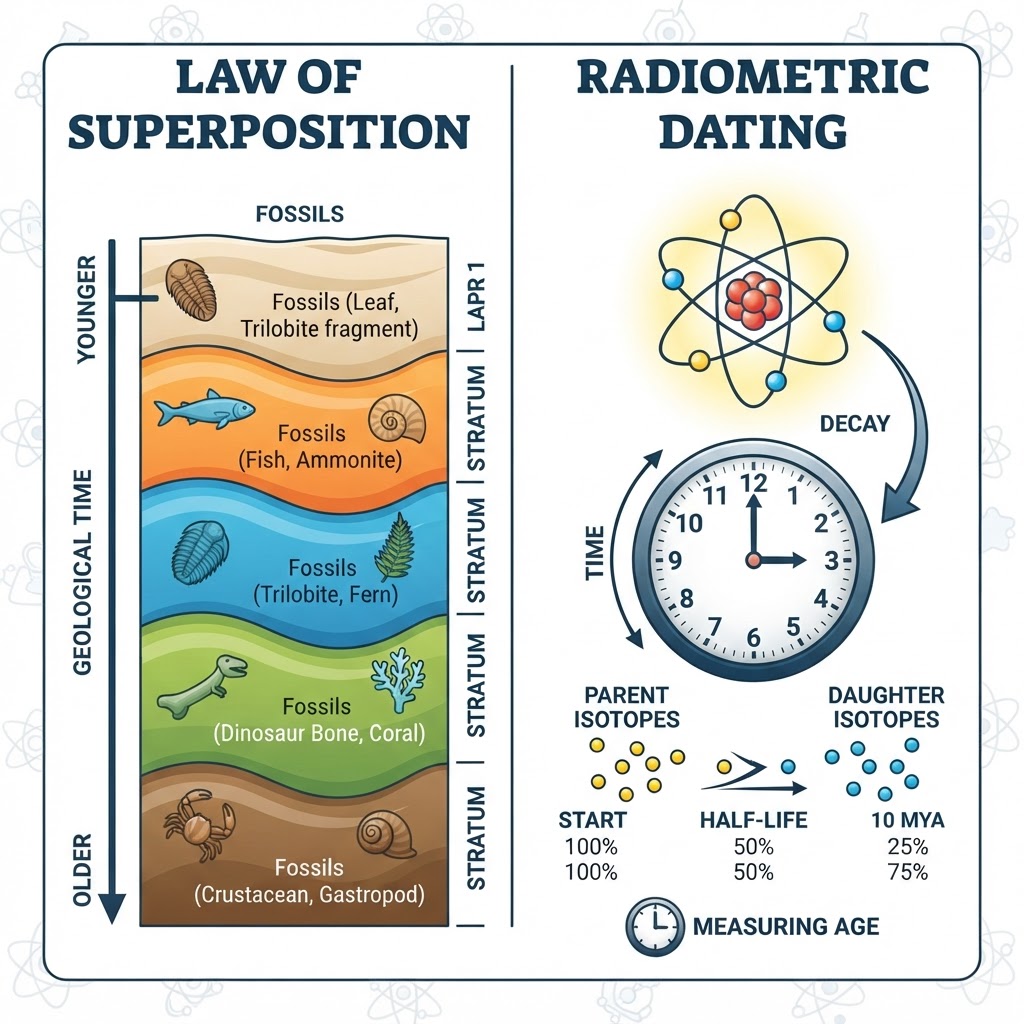
Have you ever held a fossil and wondered, "How long ago did this creature walk the Earth?" For paleontologists, a fossil without a date is like a book with its pages shuffled—it tells a story, but you cannot follow the plot. To reconstruct the history of life on Earth, scientists use two primary "time-telling" strategies: relative dating and absolute dating. By combining these methods, researchers can place ancient organisms into a precise chronological timeline [3, 6].
Relative Dating: The Law of Superposition
Relative dating is the art of determining the sequence of events without needing a specific number [3, 4]. Think of it like a stack of laundry: the shirt you threw in the hamper on Monday is at the bottom, while the one you added on Friday is at the top.
The Law of Superposition
In geology, this is known as the Law of Superposition [1, 5]. Sedimentary rocks form in layers called strata. Generally, the oldest layers are deposited first at the bottom, and younger layers accumulate on top [1, 4]. If a paleontologist finds a trilobite in a lower rock layer and a fish fossil in a layer above it, they know the trilobite is older [10].
Index Fossils
Scientists also use "index fossils" to date rock layers [4]. These are remains of organisms that were widespread, lived for a short geological time, and are easily recognizable. If you find an index fossil in a layer, you can infer the age of that layer—and any other fossils found within it—based on when that species existed [4].
Absolute Dating: The Geological Clock
While relative dating tells us what came first, absolute dating provides the "birth certificate" of a fossil [2, 3]. This method uses the chemistry of rocks to calculate an actual age in years [2, 6].
Radiometric Dating
The most common form of absolute dating is radiometric dating [6, 8]. Many rocks contain radioactive isotopes—unstable atoms that decay into stable "daughter" isotopes at a constant, predictable rate known as a half-life [6, 8].
By measuring the ratio of parent isotopes to daughter isotopes in a sample, scientists can calculate how much time has passed since the rock formed [6, 8]. For example, Carbon-14 dating is famous for dating organic materials, though it only works for fossils up to about 50,000 years old due to its short half-life [8]. For much older dinosaur fossils, scientists look at the volcanic ash layers surrounding the bones, using elements like Potassium-Argon to date the rock itself [6, 9].
Conclusion
Neither method is perfect on its own. Relative dating provides the big picture of Earth's history, while absolute dating fills in the specific dates [3]. Together, they allow us to turn mysterious stone fragments into a clear, chronological map of life’s incredible journey on our planet.
Frequently Asked Questions
Can we use Carbon-14 to date dinosaur fossils?
No. Carbon-14 has a relatively short half-life and is only useful for organic materials up to about 50,000 years old. Dinosaurs went extinct 66 million years ago, so scientists use other isotopes with longer half-lives to date the rocks surrounding those fossils [8].
What happens if rock layers are disturbed?
Geological events like earthquakes, erosion, or volcanic intrusions can flip or remove layers [1]. Paleontologists are trained to spot these disturbances by looking for "cross-cutting relationships," where a younger rock feature cuts through older layers [1, 9].
Is absolute dating always 100% accurate?
While radiometric dating is highly precise, it involves a margin of error. Scientists often use multiple samples and different dating methods to cross-check their results and ensure the highest level of accuracy [7].