How Do Fossils Form? The Science of Ancient Preservation
Ever wonder how a bone turns into stone? Discover the incredible journey from living organism to fossilized treasure in this beginner's guide.
Introduction: Nature’s Time Capsules
Have you ever held a fossil and realized you were touching something that lived millions of years ago? It feels like magic, but it is actually a remarkable geological process. At FossilFlip, we believe every fossil has a story to tell, but to understand that story, you first need to understand how these ancient remnants survive the relentless passage of time. Fossilization is rare, accidental, and utterly fascinating.
The Anatomy of a Fossil: What is Preservation?
Fossils are the preserved remains, impressions, or traces of past life. However, not everything that dies becomes a fossil. In fact, most living things disappear without a trace, consumed by scavengers or broken down by bacteria. For a fossil to form, a specific set of conditions must be met, usually involving rapid burial.
The Importance of Rapid Burial
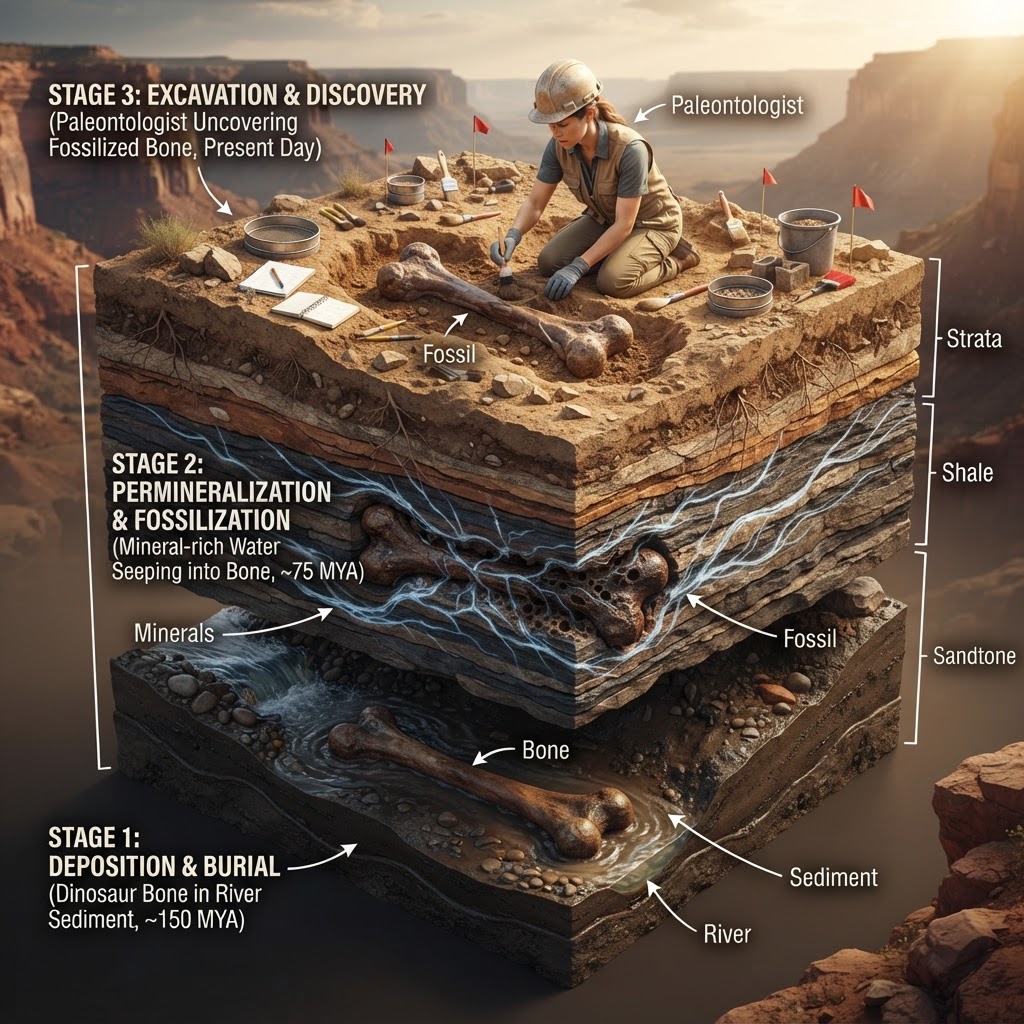
To become a fossil, an organism—whether a dinosaur, a shell, or a leaf—must be buried quickly after death. This usually happens in sedimentary environments like riverbeds, lake bottoms, or ocean floors. By being covered in mud, silt, or sand, the organism is protected from scavengers and the destructive forces of oxygen and weathering. This "anaerobic" (oxygen-free) environment is the first critical step toward preservation.
The Science of Mineralization: Turning Bone to Stone
Once buried, the real transformation begins. This is not a process of the original material staying the same, but rather a slow, chemical replacement known as permineralization.
How Permineralization Works
Think of a bone like a sponge. It is porous and filled with tiny holes. As layers of sediment build up over the organism, water rich in dissolved minerals—such as silica, calcite, or iron—seeps into these pores.
Over thousands to millions of years, the water evaporates or moves on, leaving the minerals behind. These minerals crystallize within the cellular spaces of the bone or shell. Eventually, the original organic material may decay away entirely, leaving behind a rock-hard replica that retains the exact internal structure of the original organism. This is why we can sometimes look at fossilized wood under a microscope and still see the rings of the tree!
Other Ways Life is Preserved
While permineralization is the most common method, nature has other tricks up its sleeve:
- Recrystallization: Sometimes, the original minerals in a shell (like aragonite) change into a more stable form (like calcite) without losing the shell's shape.
- Carbonization: This occurs when an organism is compressed, leaving behind a thin, dark film of carbon. This is how many beautifully detailed leaves and ferns are preserved.
- Replacement: In some cases, the original bone or shell is completely dissolved and replaced by a different mineral, such as pyrite (fool's gold).
- Entombment: Occasionally, organisms are trapped in substances like amber (fossilized tree resin) or ice, which can preserve soft tissues that usually decay.
The Role of Geological Time
It is important to remember that fossilization is a game of patience. We are talking about deep time—geological epochs that span millions of years. The shifting of Earth’s tectonic plates, the rise and fall of sea levels, and the eventual erosion of rock layers are what bring these fossils back to the surface for us to find today. Every fossil you identify with the FossilFlip app is a survivor of a long, geological journey.
Frequently Asked Questions
Q: Does every bone turn into a fossil?
A: No. Fossilization is extremely rare. Most organisms decay completely before they can be buried or mineralized. Only a tiny fraction of the life that has existed on Earth has been preserved as fossils.
Q: How long does it take for a fossil to form?
A: There is no set timeline, but it generally takes at least 10,000 years for a specimen to be considered a fossil. Most fossils we find are millions of years old.
Q: Can you find fossils anywhere?
A: You can find fossils in sedimentary rock formations. If you are in an area made of igneous (volcanic) or metamorphic rock, you are unlikely to find fossils, as the heat and pressure required to form those rocks would destroy any organic remains.