Ammonites: Unlocking the Secrets of Ancient Oceans
Discover the fascinating world of ammonites, the spiral-shelled cephalopods that serve as nature's own geological clocks for dating Earth's history.
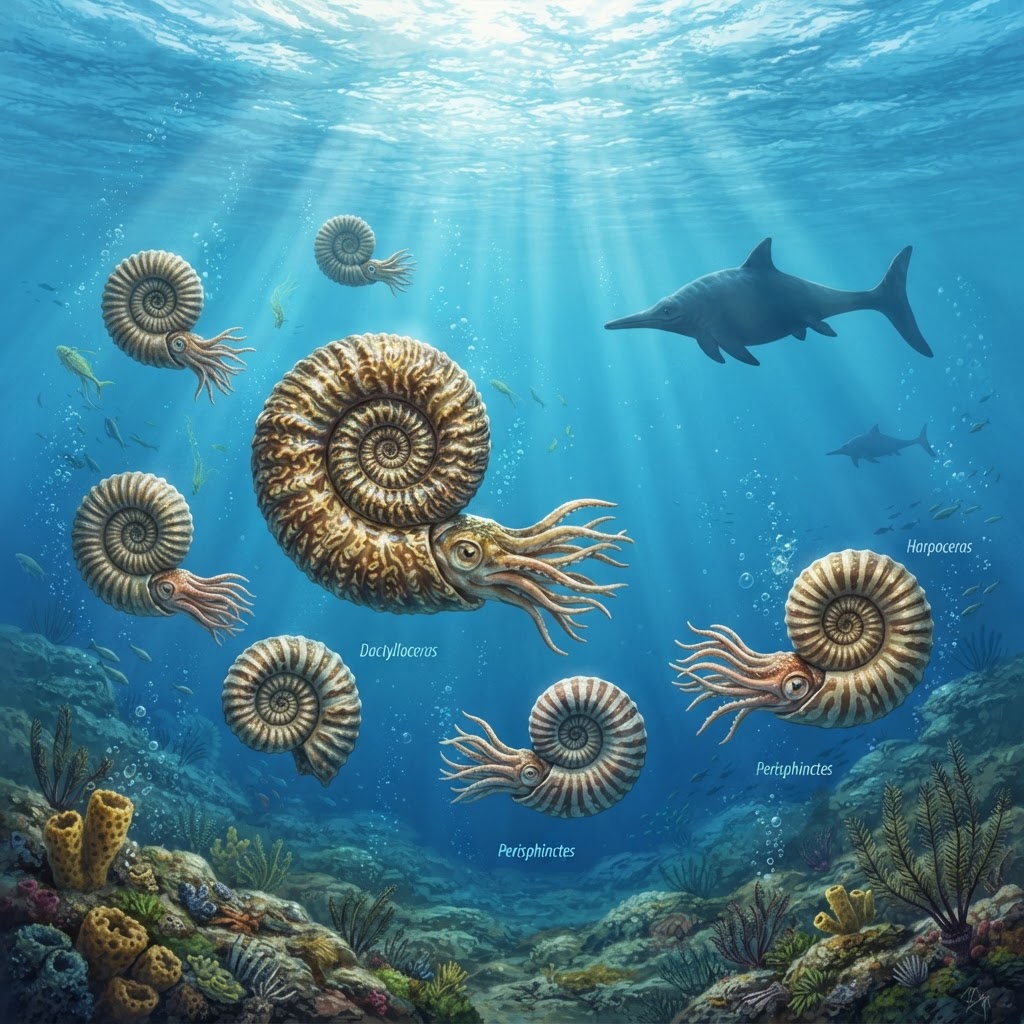
What Were Ammonites?
Ammonites were ancient, ocean-dwelling mollusks that thrived for over 300 million years, from the Devonian Period until their extinction alongside the dinosaurs 66 million years ago. Often mistaken for coiled snakes in folklore—earning them the nickname 'snakestones'—these creatures were actually cephalopods, closely related to modern squids, octopuses, and the chambered nautilus.
These animals lived in shallow seas worldwide, using their iconic chambered shells for buoyancy and protection. While we rarely find their soft bodies, their shells provide a rich record of their lives, growth, and the environments they inhabited.
How Did They Form?
Ammonite fossils are the result of a long, complex journey from the seafloor to the rock record. When an ammonite died, its shell would sink to the bottom of the ocean. If it was quickly buried by sediment, it was protected from scavengers and decay.
The Fossilization Process
Over millions of years, chemical processes transformed these shells into stone. This happened in several ways:
- Recrystallization: The original aragonite shell material slowly turned into more stable calcite.
- Casts and Molds: The shell dissolved entirely, leaving a cavity in the rock that was later filled by minerals like silica or pyrite, creating a perfect replica.
- Opalization: In rare cases, silica-rich water replaced the shell material, resulting in stunning, iridescent opalized fossils that shimmer with rainbow colors.
Why Are They 'Index Fossils'?
Ammonites are the gold standard for geologists, known as 'index fossils.' Because they evolved rapidly, specific species existed for only a short window of geological time—sometimes less than 200,000 years. If you find a specific type of ammonite in a rock layer, you can accurately date that rock to a precise moment in Earth's history. Their wide distribution across global oceans allows scientists to correlate rock layers found on different continents, effectively using them as a global clock.
What Do They Reveal About Ancient Oceans?
Beyond dating rocks, ammonites tell us about the health and structure of Mesozoic ecosystems. Their complex, frilled 'suture lines'—the patterns where internal chambers met the outer shell—strengthened their shells against water pressure, allowing them to inhabit various depths. By studying these shells, researchers can infer ancient water temperatures, predator-prey relationships, and how marine life responded to past climate changes.
Frequently Asked Questions
Are ammonites related to the modern nautilus?
Yes, they are distant relatives. Both are cephalopods with chambered shells, though ammonites are more closely related to the group that includes squids and octopuses.
Why do some ammonites have such strange shapes?
While most were flat spirals, some species, known as 'heteromorphs,' evolved bizarre, uncoiled, or hook-shaped shells. These unique forms likely helped them adapt to specific niches in the ocean.
Can I find ammonites everywhere?
Ammonites were widespread in ancient oceans, so their fossils are found globally. However, they are only found in marine sedimentary rocks, so you won't find them in areas that were once dry land or volcanic terrain.
What is the difference between a male and female ammonite?
Ammonites exhibited sexual dimorphism. Often, the smaller shell (microconch) was the male, while the larger shell (macroconch) was the female of the same species.