Fossil Hunting USA: A State-by-State Guide for Beginners
Embark on a prehistoric adventure with our guide to finding fossils across the United States, from ancient marine life to massive dinosaurs.
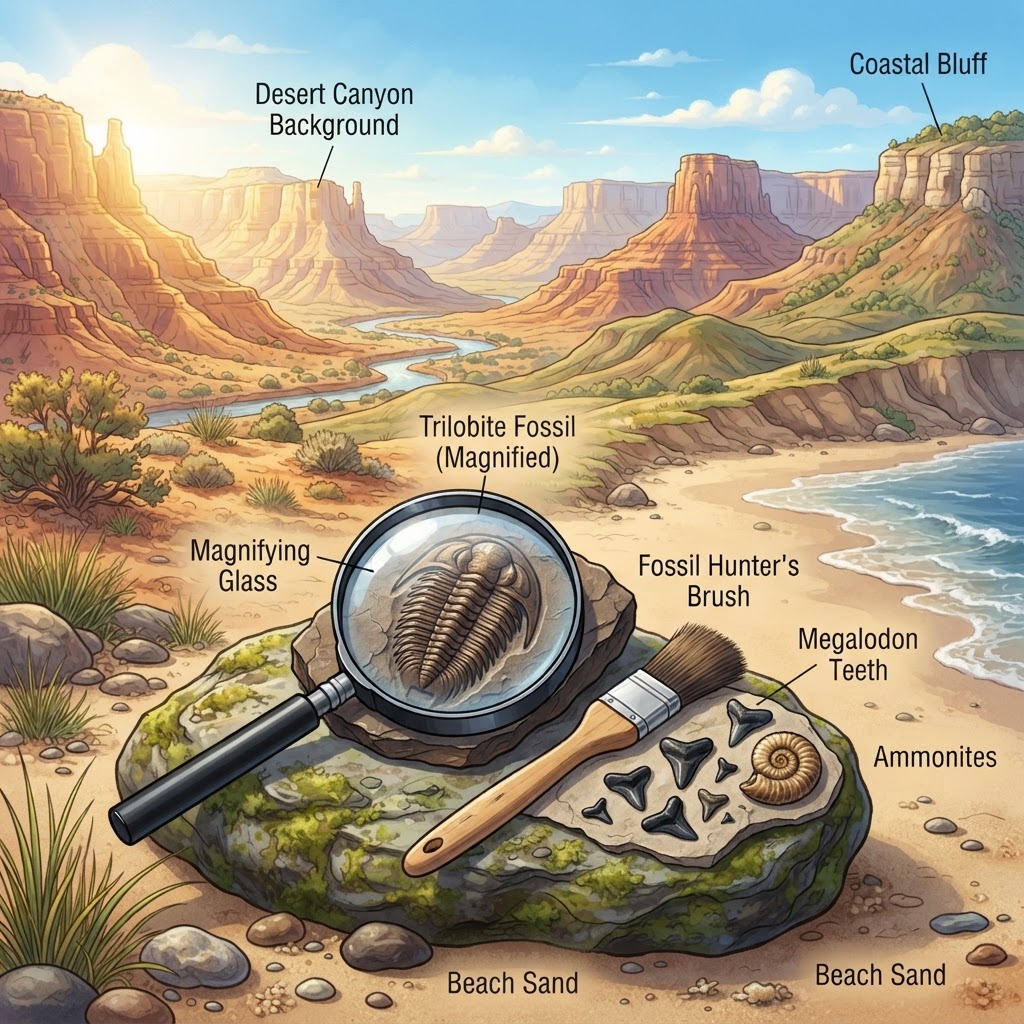
Have you ever dreamed of uncovering a piece of history that is millions of years old? The United States is a geological goldmine, offering a diverse array of prehistoric treasures hidden beneath its soil. From the rugged badlands of the West to the sandy shores of the Atlantic, the landscape is a literal time machine. This guide will walk you through some of the best states for fossil hunting and what you can expect to find in each, ensuring your first paleontology adventure is a success.\n\n## The Ultimate Map to America's Prehistoric Past\n\nThe geology of the United States is incredibly varied. Depending on where you stand, you might be walking over an ancient seabed, a lush tropical swamp, or a volcanic plain. To find fossils, you first need to understand the 'strata' or rock layers of the region. Most fossils are found in sedimentary rocks like shale, limestone, and sandstone, which formed over millions of years as layers of sediment trapped the remains of living organisms.\n\n## The Mountain West: Dinosaur Heartland\n\n### Montana and Wyoming: The Land of Giants\nIf you are looking for dinosaurs, the 'Hell Creek Formation' in Montana is legendary. This area has yielded some of the most famous Tyrannosaurus rex and Triceratops specimens ever discovered. While much of the land is private or protected, several 'pay-to-dig' sites allow enthusiasts to join professional crews. In Wyoming, the Green River Formation offers something different: exquisitely preserved Eocene-era fish. At Fossil Butte National Monument, you can see these fossils in situ, while nearby private quarries allow you to split shale slabs to find your own fossilized perch or herring.\n\n### Utah: The Trilobite Capital\nUtah is a paleontologist's playground. The Grand Staircase-Escalante National Monument is a hotbed for Late Cretaceous discoveries, including unique horned dinosaurs. For a beginner-friendly experience, the U-Dig Fossils quarry near Delta is a must-visit. Here, you can find Elrathia kingii trilobites—ancient marine arthropods that are over 500 million years old—by simply tapping on limestone rocks.\n\n## The Great Plains: The Age of Mammals\n\n### South Dakota: Badlands and Mammoths\nThe White River Badlands are world-renowned for Oligocene-era mammal fossils. Here, you can find the remains of oreodonts (sheep-like creatures), ancient rhinos, and even primitive horses. For a more 'giant' experience, The Mammoth Site in Hot Springs contains the largest concentration of mammoth remains in the world. While you can't dig there yourself, the active excavation site is a masterclass in field paleontology.\n\n### Nebraska and Kansas: The Ancient Inland Sea\nDuring the Cretaceous period, a massive 'Western Interior Seaway' split North America in two. In Kansas, the Niobrara Chalk is the place to go for marine reptiles. You can find the remains of Mosasaurs (the 'T-Rex of the ocean') and giant predatory fish like Xiphactinus. Nebraska’s Ashfall Fossil Beds provide a unique look at a prehistoric watering hole preserved by volcanic ash, featuring remarkably intact skeletons of rhinos and three-toed horses.\n\n## The Eastern Seaboard: Marine Giants and Reefs\n\n### Maryland and Virginia: Shark Tooth Beaches\nAlong the Chesapeake Bay, the Calvert Cliffs are a premier destination for Miocene-era fossils. Amateur collectors flock here to find fossilized shark teeth, including the massive, serrated teeth of the Megalodon. You can also find whale bones and ancient mollusk shells washed up on the beach after a high tide or a storm.\n\n### Florida: The Ice Age Frontier\nFlorida is perhaps the easiest state for a beginner to find fossils. The Peace River is famous for its 'gravel' which is packed with shark teeth, stingray barbs, and Ice Age megafauna. Because Florida was underwater for much of its history, then became a bridge for migrating mammals, you can find a mix of marine life and terrestrial giants like mammoths and giant sloths in the same riverbeds.\n\n### New York: Devonian Deep Dive\nNew York is home to the Penn Dixie Fossil Park & Nature Reserve, ranked as the #1 fossil park in the United States. Visitors can find a variety of Devonian-era marine fossils, including the state fossil, the trilobite Phacops rana. The site is a former quarry, making it an ideal place for families to spend an afternoon hammering into the soft shale.\n\n## The Midwest: The Age of Invertebrates\n\n### Ohio and Indiana: The Cincinnati Arch\nDuring the Ordovician period, the Midwest was a shallow tropical sea located south of the equator. Today, areas around Cincinnati are world-famous for their abundance of brachiopods, bryozoans, and crinoids. Caesar Creek State Park in Ohio allows visitors to collect fossils with a free permit, making it one of the most accessible sites for budding scientists to build their first collection.\n\n## Knowing the Rules: Fossil Laws in the US\n\nBefore you grab your rock hammer, it is crucial to understand the legalities of fossil hunting. In the United States, laws vary significantly based on land ownership:\n1. Federal Lands (BLM/Forest Service): You can generally collect 'common' invertebrate and plant fossils (like shells or leaves) for personal, non-commercial use. However, vertebrate fossils (dinosaurs, fish, mammals) are protected and require a professional permit.\n2. National Parks: Collecting anything—including rocks and fossils—is strictly prohibited and carries heavy fines.\n3. Private Land: You must have explicit permission from the landowner. On private land, the fossils belong to the owner, and you can keep what you find if they agree.\n4. State Parks: Rules vary by state. Some, like Penn Dixie or Caesar Creek, encourage collecting, while others are strictly off-limits.\n\n## FAQ\n\n### Can I keep the fossils I find?\nYes, if you are on private land with permission or on specific public lands where 'hobby collecting' of invertebrates is allowed. You should never take vertebrate fossils from public land without a permit.\n\n### What tools do I need for my first trip?\nA basic beginner kit includes a rock hammer (specifically a geo-pick), a set of brushes, a magnifying glass or loupe, safety goggles, and sturdy boots. Don't forget bags and newspaper to wrap your delicate finds!\n\n### Where is the best place to take kids fossil hunting?\nShark tooth hunting in Florida or the Calvert Cliffs in Maryland is excellent for kids because the fossils are abundant and easy to spot. For a 'guaranteed' find, the Penn Dixie site in New York or U-Dig in Utah are fantastic choices.\n\n### How do I identify what I've found?\nThe FossilFlip app is a great place to start! You can also consult local geological surveys or join a regional paleontology club. Many museums also offer 'identification days' where experts will look at your treasures.