The Day the Dinosaurs Died: The Cretaceous Extinction Explained
Explore the cataclysmic event that ended the Age of Reptiles and paved the way for the rise of mammals 66 million years ago.
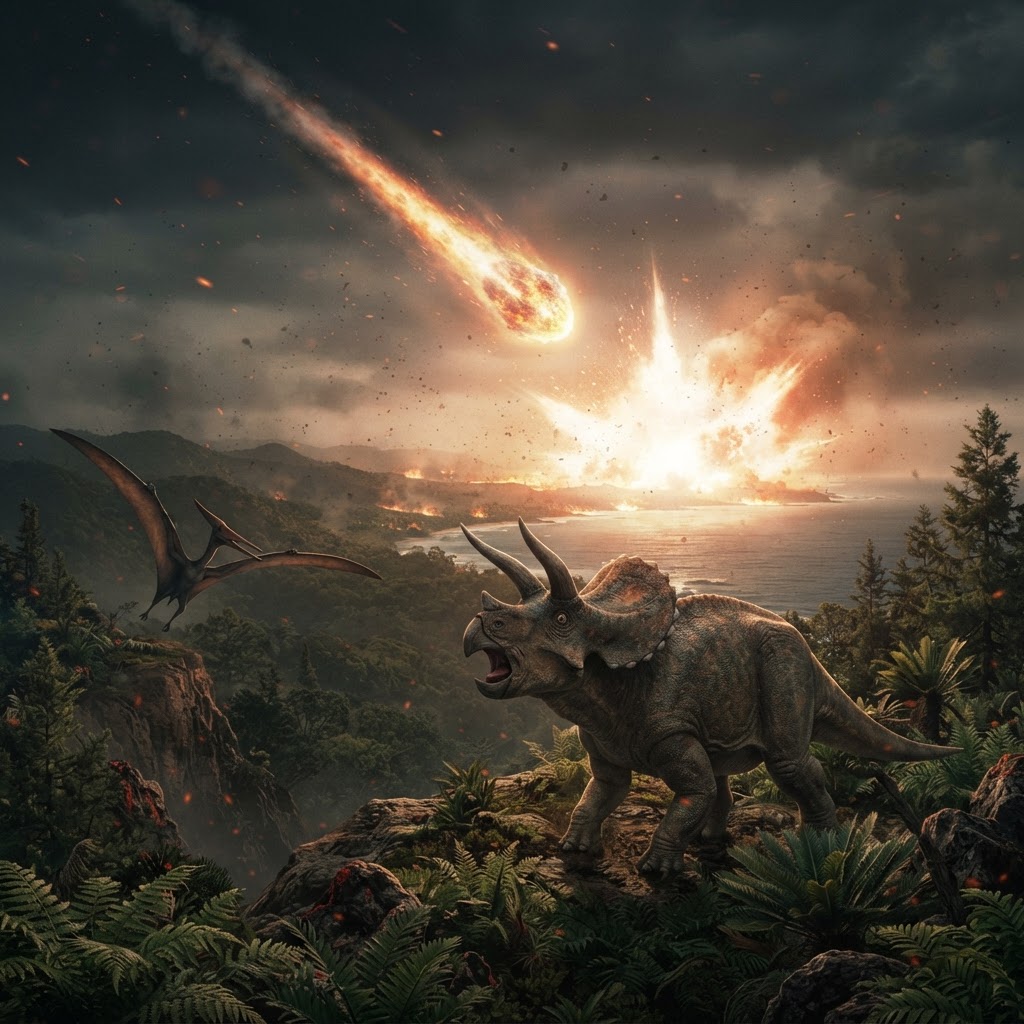
The Day the Dinosaurs Died: Understanding the Cretaceous Extinction
Imagine a world dominated by giants. For over 150 million years, dinosaurs were the undisputed masters of the Earth. From the terrifying Tyrannosaurus rex to the long-necked herbivores like Argentinosaurus, these creatures filled every terrestrial niche. But 66 million years ago, everything changed in a geological heartbeat. This turning point, known as the Cretaceous-Paleogene (K-Pg) extinction event, ended the Mesozoic Era and reshaped the history of life on our planet forever.
The Smoking Gun: The Chicxulub Impact
For decades, paleontologists and geologists debated what could have caused such a widespread collapse of biodiversity. The answer arrived in the late 1970s and early 1980s when father-son duo Luis and Walter Alvarez discovered a thin layer of clay in the Earth's sedimentary record. This layer, found worldwide at the exact boundary between the Cretaceous and Paleogene periods, contained unusually high levels of iridium—an element rare on Earth's surface but abundant in asteroids.
The Crater Beneath the Sea
The physical evidence was eventually located off the coast of Mexico’s Yucatán Peninsula. Beneath hundreds of meters of sediment lies the Chicxulub crater, a scar over 110 miles (180 kilometers) wide. Scientists estimate the asteroid was roughly 6 to 9 miles (10 to 15 kilometers) in diameter—about the size of Mount Everest—traveling at speeds of 45,000 miles per hour.
The Immediate Aftermath: A World on Fire
The impact was not just a local disaster; it was a global catastrophe. Within seconds of the asteroid striking the shallow sea, several things happened simultaneously:
- The Heat Pulse: The impact generated a thermal pulse so intense that it likely ignited forest fires thousands of miles away. Organisms not underground or underwater would have been incinerated almost instantly.
- Mega-Tsunamis: A wall of water hundreds of feet high raced across the Gulf of Mexico, scouring coastlines and dumping marine debris far inland.
- Earthquakes and Landslides: The force of the impact triggered massive seismic activity, potentially reaching magnitude 10 or 11 on the Richter scale, far more powerful than any earthquake recorded in human history.
The Long Dark: Impact Winter
While the immediate fire and floods were devastating, the true killer was what followed. The impact vaporized carbonate and sulfate-rich rocks, sending massive amounts of dust, soot, and sulfur aerosols into the atmosphere. This created a global shroud that blocked out the sun for months, perhaps even years.
The Collapse of the Food Chain
Without sunlight, photosynthesis ground to a halt. Land plants died off, and phytoplankton—the base of the marine food web—perished. This triggered a bottom-up collapse. Herbivorous dinosaurs starved first, followed quickly by the carnivores that preyed upon them. In the oceans, ammonites and large marine reptiles like mosasaurs faced a similar fate. Scientists estimate that roughly 75% of all species on Earth went extinct during this time.
Were Volcanoes to Blame Too?
While the asteroid is the primary suspect, it wasn't the only stressor on the planet. In what is now India, a massive volcanic province called the Deccan Traps was erupting. For hundreds of thousands of years, these volcanoes pumped carbon dioxide and sulfur into the atmosphere, causing significant climate fluctuations. Most experts now believe the Deccan Traps weakened global ecosystems, making them more vulnerable to the final blow delivered by the Chicxulub asteroid.
The Survivors: Why Birds and Mammals Made It
If the world was so hostile, how did anything survive? The survivors tended to be small, versatile, and capable of finding shelter.
- Small Mammals: Our ancestors were mostly rodent-sized creatures that lived in burrows. Being underground protected them from the initial heat pulse, and their ability to eat almost anything (insects, roots, decaying matter) helped them survive the long winter.
- Avian Dinosaurs: Not all dinosaurs went extinct. A specific lineage of small, feathered theropods survived. Today, we call them birds.
- Crocodilians and Turtles: These cold-blooded reptiles have slow metabolisms and live in aquatic environments, which may have buffered them against the worst of the temperature swings.
The Legacy of the K-Pg Extinction
As a fossil hunter or a paleontology enthusiast, the K-Pg boundary is one of the most significant features you can study. It represents a total reset button for life. With the giant dinosaurs gone, empty ecological niches were left behind. This