Brachiopods vs Bivalves: Telling Two Ancient Shells Apart
Discovered a prehistoric shell fossil? Learn how planes of symmetry, hinge mechanics, and evolutionary history help you easily distinguish brachiopods from bivalves.
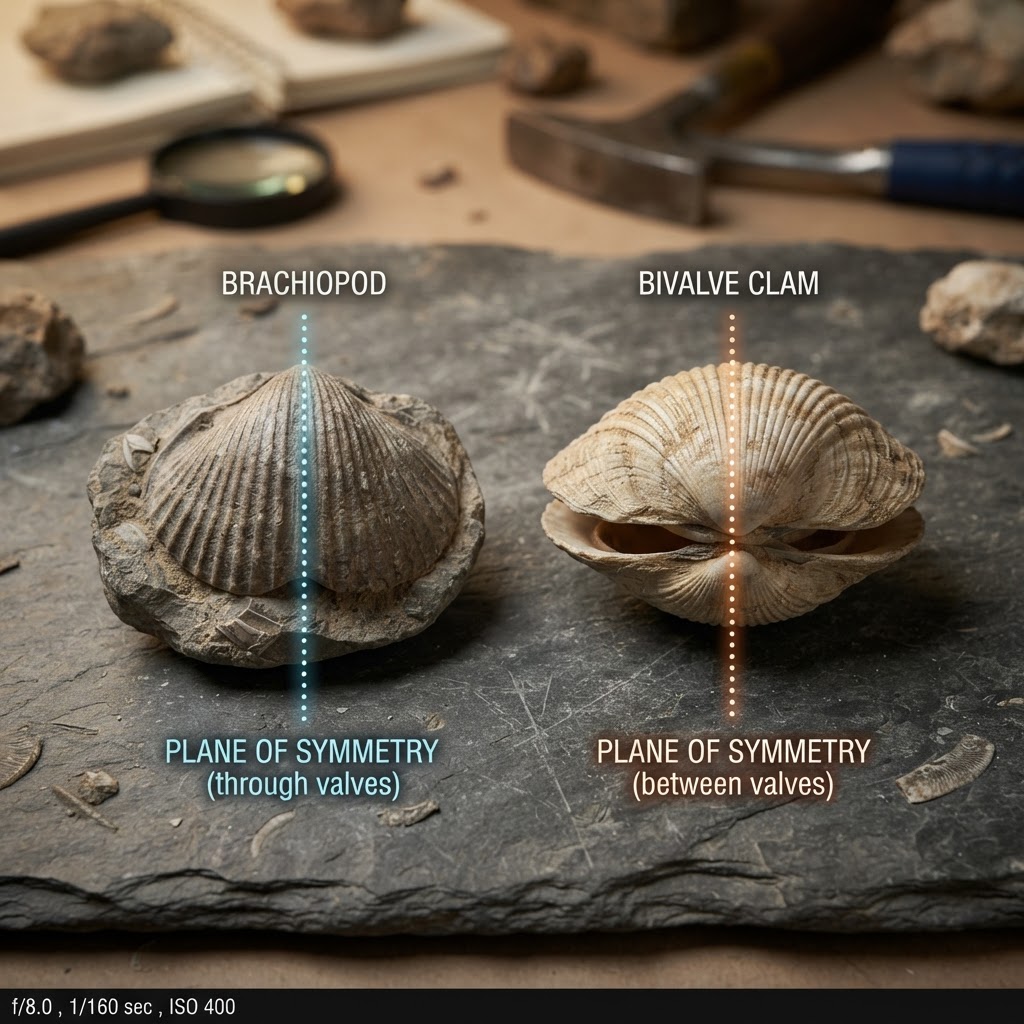
You are walking along a dry creek bed or limestone outcrop, and something catches your eye: a finely ribbed, two-halved seashell preserved in solid rock. It looks remarkably like a modern clam or scallop, but before you log it as an ancient clam, take a closer look. You might actually be holding a brachiopod—a member of an entirely distinct animal phylum that dominated Earth's seafloors hundreds of millions of years ago.
While clams and brachiopods share a passing resemblance, learning how to tell them apart is one of the most rewarding milestones for any fossil hunter. Here is your essential beginner's guide to deciphering brachiopods vs bivalves.
The Fundamental Rule: The Secret is in the Symmetry
If you only remember one rule when identifying your fossil find, make it this one: symmetry reveals the organism.
Both bivalves (such as clams, oysters, and mussels) and brachiopods (often nicknamed "lamp shells") possess two shells, technically called valves. However, how those valves relate to one another and mirror each other represents their biggest evolutionary difference, as explained by the Digital Atlas of Ancient Life:
Bivalve Symmetry: Lateral Twins
In bivalves, the plane of symmetry passes between the two valves.
- Think of your own two hands clapping together. Your left hand mirrors your right hand, but if you look at an individual hand, it is asymmetrical.
- In a clam, the left shell half mirrors the right shell half. However, if you look at a single valve straight on, the front and back of that individual shell are generally asymmetrical.
Brachiopod Symmetry: Down the Center Line
In brachiopods, the plane of symmetry cuts perpendicularly across both valves.
- Think of your own body being bisected from head to toe down the middle—your left side matches your right side.
- If you look down onto a brachiopod shell, the right half of that single valve mirrors its left half. However, the top valve (the dorsal or brachial valve) and the bottom valve (the ventral or pedicle valve) are completely different sizes and shapes, with one valve typically larger and possessing a curved "beak."
Anatomy and Mechanics: Hinges, Stalks, and Siphons
Beyond symmetry, several physical hallmarks will help you spot what kind of prehistoric creature you have discovered:
The Pedicle Opening
Many articulate brachiopods anchored themselves permanently to the ocean floor using a fleshy, root-like stalk called a pedicle. At the pointed beak of the larger ventral valve, you will frequently see a neat, circular hole called the pedicle foramen. If your shell fossil has a distinct hole or notch at its hinge point where a stalk once emerged, you are almost certainly looking at a brachiopod!
Hinge Lines and Muscle Attachments
- Bivalves rely on an elastic hinge ligament that naturally pops the shell open when resting. They use strong internal adductor muscles to pull the shells tightly shut against predators.
- Brachiopods operate differently: they utilize antagonistic sets of muscles (adductors and diductors) working with interlocking teeth and sockets along the hinge to actively lever the shell open and pull it shut, as noted by ScienceInsights.
Soft Tissues: Lophophores vs Gills
Although soft parts rarely fossilize, understanding their anatomy explains their shell shape. Brachiopods do not possess the burrowing muscular "foot" or siphon tubes that clams use to move and siphon water. Instead, brachiopods house a delicate, ribbon-like filter-feeding organ fringed with cilia, called a lophophore, which sweeps microscopic plankton and nutrients directly into the shell cavity.
The Great Ecological Changing of the Guard
Why does finding a brachiopod feel like striking geological gold? It comes down to evolutionary history.
During the Paleozoic Era (from roughly 538 to 252 million years ago), brachiopods were undisputed kings of the seafloor. Thousands of species carpeted shallow marine shelves, outnumbering bivalves by an enormous margin.
However, everything changed 252 million years ago during the Permian-Triassic mass extinction (the "Great Dying"), the most catastrophic extinction event in planetary history. As highlighted by the Digital Atlas of Ancient Life, over 90% of marine species vanished, and brachiopods were devastated. In the aftermath, mollusks—especially bivalves—proved more adaptable, burrowing into sediment to evade predators and harsh conditions. Today, bivalves dominate marine and freshwater environments, while living brachiopods are relatively rare survivors relegated to cold or deep ocean niches.
Quick Identification Checklist
When holding your fossil, run through this quick checklist:
- Is the single shell symmetric down its midline?
- Yes → Likely a Brachiopod.
- No → Likely a Bivalve.
- Are the top and bottom valves identical in size and curvature?
- Yes → Likely a Bivalve (left and right valves).
- No → Likely a Brachiopod (dorsal and ventral valves).
- Is there a distinct round hole at the hinge beak?
- Yes → Definitive sign of a Brachiopod pedicle opening.
- What age is the host rock?
- If your fossil comes from Paleozoic bedrock (e.g., Ordovician, Silurian, or Devonian limestone), the probability of finding a brachiopod is exceptionally high!
Frequently Asked Questions (FAQ)
Are brachiopods considered mollusks?
No. Although older natural history texts occasionally grouped them together, brachiopods belong to their own phylum, Brachiopoda, while clams and oysters belong to phylum Mollusca. Brachiopods are actually more closely related to bryozoans (moss animals) and phoronids than to modern clams.
Why are brachiopods called "lamp shells"?
Many articulate brachiopods (particularly members of the order Terebratulida) feature an inflated ventral valve that tapers to a curved beak with a hole at the tip. When viewed from the side, this shape closely mirrors the design of ancient Greco-Roman terracotta oil lamps, where the pedicle opening resembles the wick aperture.
Can you still find living brachiopods today?
Yes! While they no longer dominate ocean ecosystems as they did during the Paleozoic, several hundred living brachiopod species still exist worldwide. Famous modern examples include Lingula (an inarticulate brachiopod that lives in vertical sediment burrows) and cold-water articulate species found in the Pacific Northwest, New Zealand, and polar shelves.
Which one is more common to find as a fossil?
It depends on the age of the rock layer! In Paleozoic rocks (older than 252 million years), brachiopod fossils are vastly more abundant and diverse. If you are fossil hunting in Mesozoic or Cenozoic strata (younger rocks), bivalve fossils are far more common.