Brachiopods vs Bivalves: Telling Ancient Shells Apart
Discovered a fossil shell and not sure if it is a clam or a lamp shell? Learn the symmetry trick to easily distinguish brachiopods from bivalves.
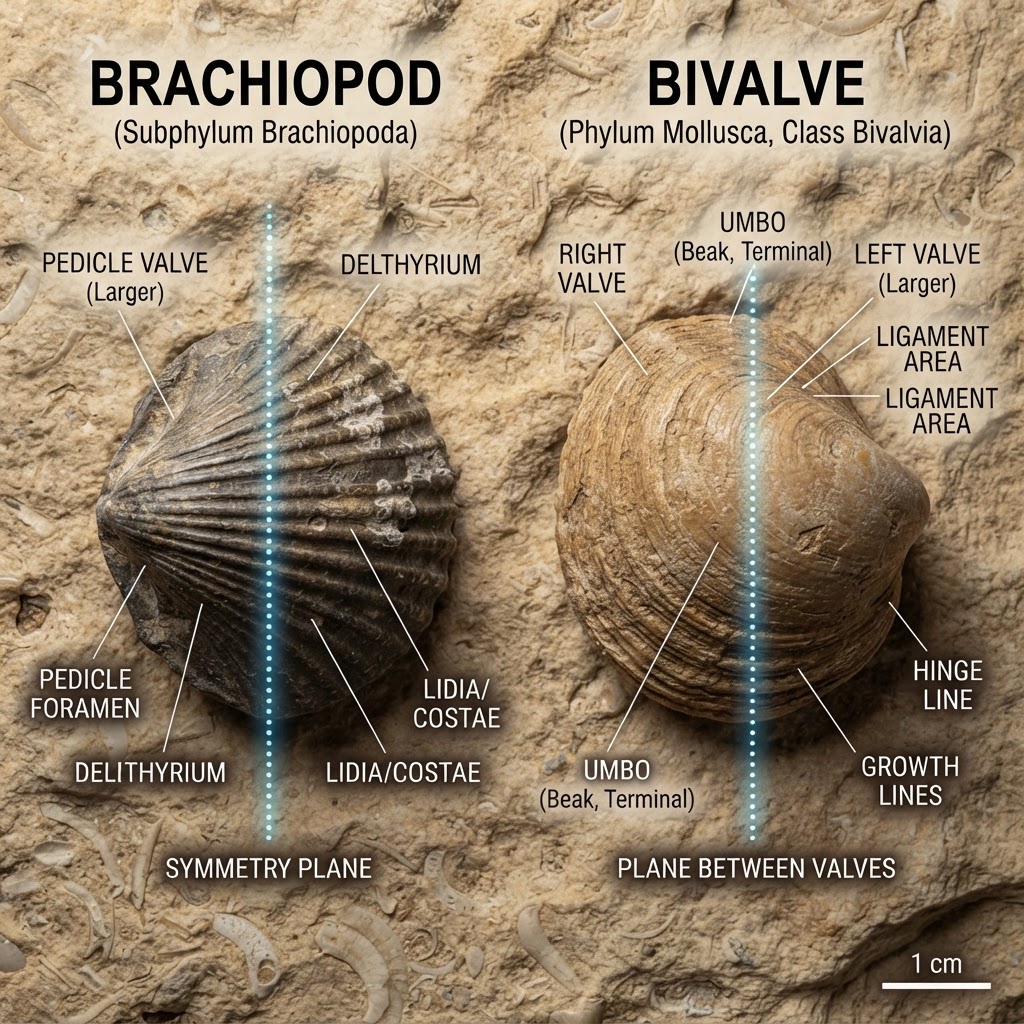
Imagine you are combing through an ancient limestone quarry or gravel bed, and you spot a ridged, two-part shell petrified into the rock. Your first instinct might be to shout, “I found a fossil clam!” While that might be true, there is an equally exciting possibility: you may be holding a brachiopod—a creature from an entirely different phylum that ruled the Paleozoic seas hundreds of millions of years before modern clams took center stage.
Because both animals built protective, hinged shells made of two valves, telling them apart is one of the classic challenges in fossil hunting. Fortunately, nature left behind a clever geometric clue: shell symmetry. Here is your beginner-friendly guide to mastering the difference between brachiopods and bivalves.
Two Completely Different Animal Families
Although their fossils can look strikingly similar at first glance, brachiopods and bivalves are only distant cousins on the tree of life:
- Bivalves belong to the phylum Mollusca (the same major group that includes snails, octopuses, and squids). Familiar examples include clams, oysters, mussels, and scallops.
- Brachiopods belong to their own distinct phylum, Brachiopoda. Often nicknamed "lamp shells" due to their resemblance to antique Roman oil lamps, they feed using a delicate, coiled, tentacle-bearing organ called a lophophore, as detailed by the Paleontological Research Institution.
While bivalves dominate today's modern beaches and grocery store seafood counters, brachiopods were the undisputed monarchs of the ancient Paleozoic ocean floor. The National Park Service notes that brachiopods suffered catastrophic losses during the End-Permian mass extinction roughly 252 million years ago, allowing bivalves to radiate and dominate post-Paleozoic marine ecosystems.
The Golden Rule: Check the Line of Symmetry
The most dependable diagnostic tool for differentiating these two fossils in the field is analyzing bilateral symmetry.
1. Bivalves: Symmetrical Between the Valves
Think of a clam shell like a pair of human hands clapping together.
- The plane of symmetry passes between the two valves along the hinge line.
- The left valve and right valve mirror each other.
- However, if you look at a single valve individually from the front, it is typically asymmetrical—one side curves toward the beak (the anterior end), while the other slopes toward the posterior end.
2. Brachiopods: Symmetrical Down the Middle of Each Valve
Think of a brachiopod like a human face divided straight down the nose.
- The plane of symmetry cuts perpendicularly through the middle of each valve.
- If you draw an imaginary line from the hinge straight to the front lip of a single valve, the left and right halves mirror each other.
- However, the two valves themselves are unequal: the lower ("pedicle") valve is typically larger and shaped differently from the upper ("brachial") valve.
Quick Memory Hack:
- Bivalves: Equal shells, unequal halves.
- Brachiopods: Unequal shells, equal halves.
Other Key Field Clues
Beyond symmetry, look for these telltale anatomical features when examining your fossil:
The Pedicle Opening
Many articulate brachiopods anchored themselves permanently to hard surfaces or the seabed using a fleshy, muscular stalk known as a pedicle. In fossils, you can often see a distinct circular hole or triangular notch (the delthyrium) right at the pointed beak of the larger valve. Bivalves do not have this hole; they typically move using a muscular foot or anchor using fibrous threads called a byssus.
Hinges and Gaps
- Bivalves rely on an elastic organic ligament located on the outside or inside of the hinge to spring their shells open, balanced by adductor muscles that pull them shut. When bivalves die, this ligament frequently decays, causing the two shells to separate.
- Articulate brachiopods feature interlocking calcium carbonate "teeth and sockets" along their hinge line, operated by opposing muscle sets to open and close. Because of this interlocking mechanism, fossil brachiopods are very frequently discovered with both valves intact and tightly shut.
Why Knowing the Difference Matters
Correctly identifying your fossil shell opens up a window into Earth’s deep past. If your fossil is a brachiopod, you are likely looking at rock layers deposited during the Paleozoic Era (such as Ordovician, Silurian, or Devonian limestone), pointing to an ancient, shallow saltwater sea teeming with stalked crinoids and trilobites. If it is an asymmetrical clam or mussel, it might tell a completely different story of sandy Mesozoic shores or freshwater river deposits.
Frequently Asked Questions (FAQ)
Are brachiopods extinct?
No, but their numbers are vastly reduced! Around 350 living species survive today, mostly found in cold polar regions or cryptic, deep-water ocean habitats, compared to over 12,000 described fossil species.
Can you eat a brachiopod?
While theoretically edible, brachiopods are not culinary favorites. Unlike meaty clams, a brachiopod’s interior is dominated by watery mantle cavity and the spiraled lophophore feeding apparatus, leaving very little edible muscle tissue.
Why do some bivalves look asymmetrical like oysters?
While most standard clams exhibit equal left and right valves, cemented or burrowing bivalves (like oysters or rudists) evolved irregular forms to suit their substrate. Even so, oysters lack the strict central line of symmetry seen down the middle of a brachiopod valve.
What should I do if my shell is broken or embedded in rock?
Look at the growth lines! If the concentric growth rings form symmetrical arches centered on the hinge apex, you are almost certainly looking at the valve of a brachiopod.